
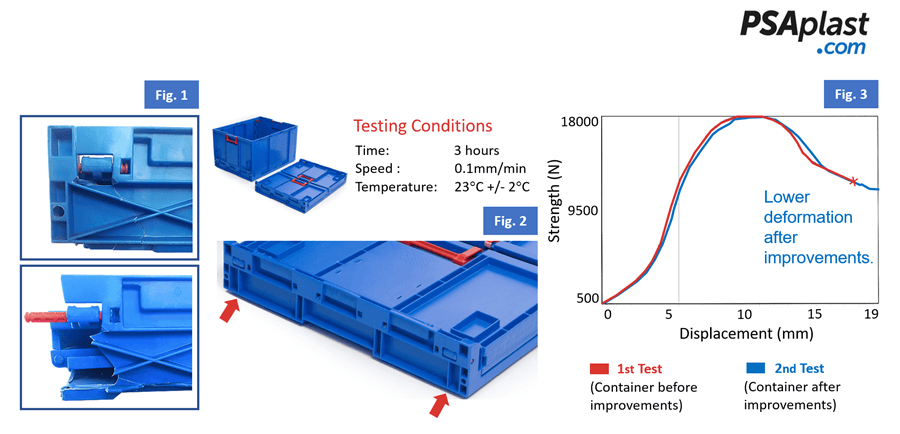
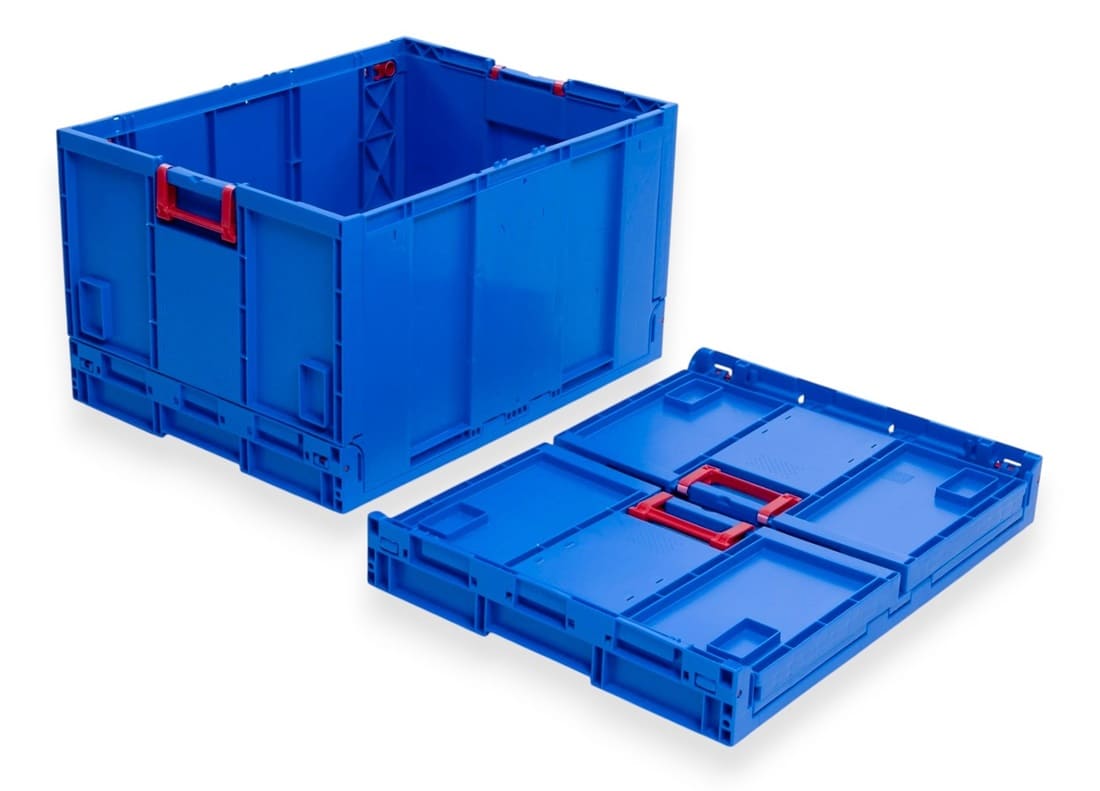
A foldable plastic container is expected to withstand thousands of operating cycles throughout its service life. Stacking, transportation, opening and closing, repeated handling, and heavy loads continuously challenge its structural integrity. Ensuring long-term durability is one of the biggest engineering challenges in the development of industrial plastic packaging.
In this article, we explain how design optimisation – supported by mechanical testing and structural analysis – significantly improved the strength and durability of our 800x600mm foldable container.
Logistics benefits and structural challenges
Folding boxes have become a standard solution in logistics, manufacturing and warehousing because they offer significant operational and economic advantages, particularly in returnable packaging systems.
Their main benefits include:
• Optimised return transport: once emptied, containers can be folded, dramatically reducing the volume required during return shipments.
• Lower transport costs: more folded containers can be transported per trip, reducing freight, fuel consumption and handling costs.
• Improved warehouse utilisation: folded containers require considerably less storage space.
• Higher operational efficiency: easier handling and storage of empty containers simplifies warehouse operations.
• Sustainability: fewer transport journeys and better vehicle utilisation contribute to lower CO₂ emissions.
• Reusability: designed for repeated use, they provide a more durable and cost-effective packaging solution.
• Ease of handling: quick folding and assembly, reduce preparation and handling times.
• Compatibility with automated logistics systems: stackable in both assembled and folded configurations, improving storage and transport efficiency.
• Reduced packaging waste: replacing disposable packaging (such as cardboard boxes) supports a more circular economy.
While these advantages are well known, foldable containers are also subjected to demanding mechanical conditions throughout their service life. Every day they experience stacking loads, transportation impacts, repeated opening and closing cycles, loading and unloading operations, and long-term storage under heavy loads.
Although these containers appear highly robust, stress concentrations can gradually initiate cracks that eventually lead to structural failure.
The engineering challenge is to identify these critical areas before failures occur in real-world applications.
Why mechanical testing matters
At PSAPlast, we believe that product performance depends on far more than a good mould or high-quality raw material. True durability results from the combination of intelligent structural design, a controlled injection moulding process, and thorough experimental validation.
Before approving any design, we carry out mechanical testing to understand how the container behaves under realistic loading conditions.
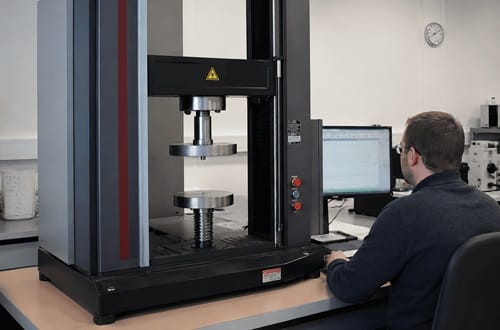
One of these tests consists of a controlled compression test, during which the force required to deform the container is continuously recorded.
The objective is not simply to determine the maximum load the container can withstand.
More importantly, we want to understand where the structure begins to fail and why.
This is often where the greatest opportunities for product improvement are found. The tests showed that the original container exhibited excellent initial stiffness.
However, as the load increased, stress became concentrated in specific regions of the structure, leading first to crack initiation and ultimately to structural failure.
Design improvements
Following analysis of the test results, several modifications were introduced to the container design.
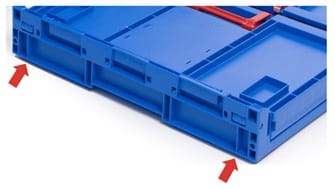
Following analysis of the test results, several modifications were introduced to the container design.
The main improvements included:
• reinforcing the structure around the hinges of the short side walls;
• removing ribs that contributed little to the mechanical performance;
• increasing corner radii to reduce stress concentrations.
At first glance, these changes may appear relatively minor.
However, in injection-moulded plastic parts, even small geometric modifications – such as increasing a corner radius or redesigning a reinforcing rib – can significantly reduce stress concentrations and improve fatigue resistance without increasing the overall weight of the component.
The results
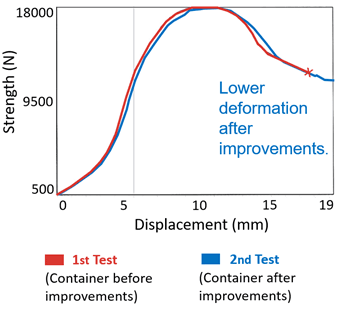
Compression testing clearly demonstrated the different mechanical behaviour of the two container designs.
The original version displayed slightly higher initial stiffness, requiring greater force during the early stages of deformation.However, once the maximum load was reached, the structure failed prematurely, preventing the container from achieving the target deformation of 18 mm.
The optimised design showed a slight reduction in initial stiffness due to the redistribution of material and geometric changes. Rather than being a disadvantage, this proved beneficial.
The improved geometry distributed stresses more evenly throughout the structure, preventing local overloads.
As a result, the redesigned container maintained its structural integrity even after reaching maximum load, successfully completing the full 18 mm deformation without any structural failure.
This illustrates an important engineering principle: A structure that is slightly less stiff can actually be stronger and more durable if it distributes loads more efficiently and reduces stress concentrations.
In practical terms, this means improved resistance during everyday use and a significantly lower risk of failure throughout the product’s service life.
Factors such as wall thickness, rib design, reinforcement location, corner radii, load distribution and the injection moulding process all have a major influence on the final mechanical performance.
This is why product development at PSAPlast combines engineering expertise, mechanical testing and continuous design optimisation.
Engineered for long-term performance
The real challenge is not simply to design a plastic container that can withstand a high load once. It is to develop industrial packaging that is simultaneously: strong; lightweight; functional; durable; and cost-effective.
This is the engineering philosophy behind every industrial container developed by PSAPlast.
Because the best packaging is not the one that survives a single load test.
It is the one that continues to perform reliably after hundreds (or even thousands) of operating cycles.
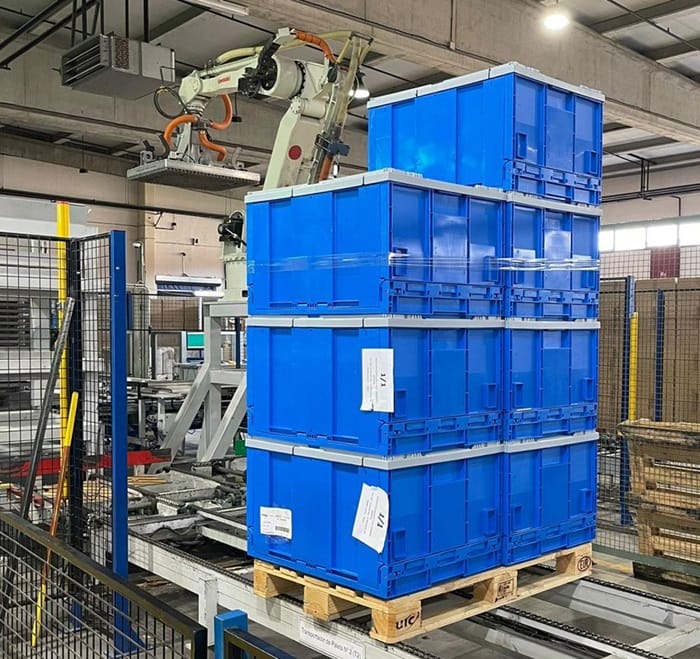
Looking for durable industrial plastic packaging?
At PSAPlast, we develop industrial packaging solutions engineered to meet the demanding requirements of modern industry, combining strength, functionality, durability and operational efficiency.
By integrating intelligent design optimisation, careful material selection and comprehensive mechanical testing, we produce plastic containers capable of performing reliably in the most demanding applications.
Whether you are looking for heavy-duty plastic boxes, foldable containers or reusable industrial packaging, PSAPlast has the engineering expertise to deliver a solution built to last.
For more information or any request, please contact us via our website.